


Exploring Antigua
- georgiaphillips210
- Mar 31
- 8 min read
Trip date December 2025 1GBP = 10.15 Guatemalan Quetzal March 2026
From far away in Flores (the most north eastern part of Guatemala) there was three options to get to Antigua and to be entirely honest, they all sucked.
There was the road route via Semuc Champey - this would require two eight hour (or most likely more) stints in a cramped tourist shuttle, but we would get to see the iconic waterfalls. Alternatively, the route via Rio dulce would be one long travel day of twelve plus hours... or, we could fly.
With flying falling outside our budget and travel style, we decided to go via Rio Dulce, but with a break in the middle. The wonders of Semuc Champey almost won out, but the long days stuck on a bus were enough to put us off. We were happy to go out of our way for a cool experience, but with our recent Mexico adventures featuring quite a few days spent suffering from motion sickness stuck in a coach, we needed a break and two shorter travel days seemed more manageable.

We had booked our bus tickets from the "Terminal Central de buses" the day before, we'd heard that there was a possibility of them being fully booked if we just turned up in the morning so we wanted to be precautious. The bus was slow, not only was the traffic fairly constant, but we also stopped on multiple occasions to let vendors on board. The most impressive of these vendors managed to make full meals in the buses aisle as it continued swaying its way down the road. While her balance was impressive, we passed on the meal, happy to enjoy the snacks we'd brought with us.
After five long hours we arrived in Rio dulce, where from a pre-arranged restaurant, our hotel sent a boat to bring us to their riverside lodge. We'd chosen "Casa Perico", a rather rustic hostel with its own restaurant. It was far from perfect with shared bathrooms and mosquitos determined to eat us alive, but we thoroughly enjoyed our stay. The beds were comfy enough, the hammocks even more so, and the restaurants food was reasonably priced and actually quite good.
We could have taken out complimentary kayaks to explore the area but we committed ourselves to a full on chill day instead. We stayed for two nights, which was enough. Any more days and we wouldn't have been able to afford it, not because it was expensive but because they only took cash and we only brought so much with us.

Through them we arranged our next leg of transport to Antigua for 250Q per person. On the morning of departure they dropped us back to civilisation, a small cafe the tourist shuttle would depart from. When we finally boarded the bus we heard the words you never want to hear "You might want to go to the bathroom before departure, there's been an accident on the road and it's likely to take five hours to reach the rest stop instead of three."
It was going to be a long day.
After everyone on board tromped their way up and off to the toilets, the bus finally left at 11.30am and we didn't arrive till 9.30pm - so much for a shorter trip! If I could have a re-do I'd get the local bus over a shuttle; with the accident it would have taken just as long but at least it wouldn't have been quite so cramped! Lesson learned.
We arrived in Antigua with just enough time to drop our bags off at our accommodation and rush to Parque La Merced, where street food stalls set up in the evening. So late in the day, they were our only hope to grab some grub before sleep, and luckily for us the food yummy too. I had some pupusa (El Salvadorian stuffed corn tortilla) and Ben went for a meat filled sandwich, nothing fancy but it did the job.
After a well earned sleep we finally got stuck in to exploring Antigua, starting with one of its many destroyed religious sites "Conveto de la Recoleccion". Antigua was once the proud capital of colonial Guatemala and as the political and religious centre for the region, it was home to many grand buildings and a frankly ridiculous number of convents and churches. This all came to a halt in the 18th century when it suffered through two catastrophic earthquakes, one in 1717 and 1773, which turned to rubble the most elaborate of the city's structures. As the city was abandoned in 1776, and has since had very strict regulations regarding new construction and repair, a lot of the ruins have been only tidied and made safe, but largely left in place.
The Convento de la Recoleccion was the most ruinous of the sites we'd visited. It gave the appearance of a half finished puzzle, with some of the walls and arches left intact but mammoth sections of the ceiling scattered where the pews would have once sat, like it was waiting for some giant to put it back together again. It was fascinating, in a macabre way, to see how the church was put together, the layers within the walls, the inner workings exposed. It was hard to fathom how it would have felt to be present during the earthquake, the horror that would have been present as the city came crashing to the ground.


We wandered around the church and attached convent, taking an hour to explore every nook we could. Of all the convents we visited, this one was by far the quietest and well worth the 40Q per person we paid on entry.
From there we headed across town to the Ruins of Convento Santa Clara, which also cost us 40Q each to enter. This site was far more manicured than the one we left and had a handy map at its entrance that helped to make sense of the layout. The larger pieces of fallen masonry in the convent had been replaced with planted gardens and places to relax - we saw groups of locals bringing in picnics and takeaway pizza to eat in the grounds. My favourite part of the Santa Clara convent was the well preserved stone church, its shell almost entirely intact except for the domes which have been replaced with fibreglass replicas which illuminated the church with a honeyed light.

The third ruined convent we visited, Convento de la Merced, was adjacent to a intact and active church. The Saturday we visited the church itself was actually off limits due to the back-to-back weddings that were taking place, but luckily the ruins could still be accessed after paying 35Q per person. Of all the ruins we visited these were by far the least impressive, and if they were the whole reason for visiting I'd have been disappointed. However, our entry fee also allowed us access to the church roof and we couldn't pass that up.


It's not exactly a secret and there was plenty of other people wandering about the place, but it still felt pretty special. We climbed a set of stairs to a bell tower, and from there we had to remove our shoes to protect the chalky white covering of the roof. An attendant let us know that we only had 20 minutes to explore but that was plenty. Unfortunately clouds covered the tops of the two iconic volcanos that tower over Antigua, Fuego and Agua, but we still enjoyed the view over the neatly laid out town below us. What I enjoyed more than the view was the details of the church that were far less distinct from the street below... especially the lions dotted around the largest cupola. I have to imagine that the artist had a) never seen a real lion before or b) never intended for them to be seen up close because wow were they... erm, unique.

To round off our exploration of ex-convents, we headed to "Santuario San Francisco el Grande, a large active catholic church with convent ruins and an adjacent museum about Saint Hermano Pedro. Entry was 35Q per person, but we could have entered the church itself for free. The museum was strange, from what I could piece together from the mostly Spanish descriptions was that Saint Hermano preformed the miracle of healing, that or he was a serial thief of crutches judging by the amount on display.
The convent ruins themselves were slightly different to the others that we had seen, in that certain areas were plainer and housed a hospital and a college of healing where Saint Hermano did his work in the 17th century. The areas of the main convent that remain still show detailed baroque techniques in the stucco that have somehow survived not only the earthquakes but also being out in the elements for the following centuries.

We didn't, of course, visit all these convents in one day. That would have been a bit much, and even visiting four spread over several days got a little repetitive in the end. They each had different aspects that I enjoyed, but I have to admit that the first we visited was the most memorable to me. The masonry strewn about, the many rooms of the convent I couldn't make sense of, the staircases leading to floors that not longer exist - it left me with questions and simultaneously made me feel more like an explorer trying to seek out the details to answer them. The manicured aspects of the others were beautiful, but made the sites feel less real and raw, at least to me.
When not exploring ruins, we explored the town instead.
One morning we headed up the steep, steep stairs to the Cerro de la Cruz viewpoint. Okay, the steps weren't all that steep, but being at 1500m of elevation sure kicks ass when we had been relaxing at sea-level for quite a while. Luckily, the viewpoint was also home to plenty of seats, so we could sit and get our breath back while looking over stunning views of the town and Volcan de Agua. This was the only time in our visit to Antigua that the entirety of the iconic volcano could be seen, its peak normally hidden by a layer of clouds. A volcano we saw much more of was Fuego, a smaller (but active) volcano that lies west of the town. At night, from the rooftop of our Airbnb, we could see small lava flows erupting from its crater, the glowing red lines seemingly shooting into the sky before vanishing - not at all disconcerting.

Feeling brave, we decided to explore the market. We'd put it off on several occasions due to feeling slightly sleepy and not ready to face the sheer chaos that emanated from the place every time we passed. As we entered the stall-lined road leading into the market proper, we were met by a car also squeezing its way through. The market was a riot of textures, colours, sounds and smells. They seemed to sell anything and everything, but nothing we wanted or needed. I didn't stop to look at anything as even glancing at something on passing led to the stall holder pouncing, eager to show the rest of their wares.

The adjacent "art" market in comparison was deserted. It obviously catered to tourists, and with every stall selling the exact same thing, it made me feel that perhaps the art was likely drop-shipped from some overseas site - rather than handcrafted like they'd want us to beleive. We didn't stay long.
One of our favourite things to do about town was to take photos of chicken buses, old American school buses that now provide cheap local transport to the area. Each of them has a bespoke paint job and it was fun to try and capture the most outlandish we could find.

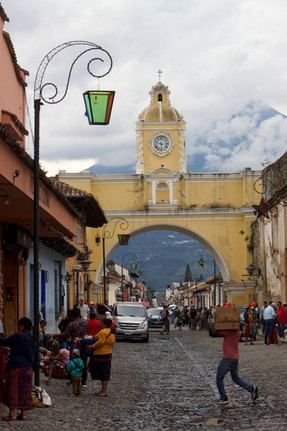
Apart from photographing buses, we also enjoyed snapping pics the town itself. Antigua is known for being one of the most beautiful cities in the world and we had lots of fun trying to capture it.




Finally, we ate lots and lots of food. The food quality in Antigua was good and there was tonnes of restaurants to chose from, but we did find it harder to find local food at a reasonable price. Two stand out places however were; Casa de Sopa, where I had a deliciously savoury black bean soup and Ben had a traditional Jocan de gallo (chicken soup); and El Peroleto, a tiny ceviche restaurant that operates out of an old laundry.
Both of these restaurants provided ridiculously large portions for a fair price, and more importantly they were both delicious. The soup restaurant did feel more touristy with menus in Spanish and English, but the ceviche place seemed popular with the locals too.
There was lots of good cake too.


Comments